
For dental labs7 min read
How to Quote Turnaround Times Your Lab Can Actually Keep
Most turnaround complaints come from mismatched definitions, not slow work. Here is how a dental lab can define, quote, and track turnaround that practices trust.

Most turnaround complaints a lab hears are not really about speed. They are about two parties using the same number to mean different things. The lab says seven days and means seven business days from the moment the case clears intake, before shipping. The front desk hears seven days and books the patient for next Friday.
Fixing this does not require working faster. It requires defining your turnaround clearly, quoting it by case type, and telling practices early when something changes. Here is how to do that this week.
Define when the clock starts and stops
Write down, in one or two sentences each, exactly what starts and stops your turnaround clock.
Start of clock. Pick one event and stick with it. Common choices:
- For physical cases: when the package is scanned in at your door with a complete prescription.
- For digital cases: when the files arrive and the prescription is complete enough to begin.
Notice the phrase complete prescription. If your clock starts the moment a package lands, even if the margin is unclear or the shade is missing, you will miss dates through no fault of your production team. If it starts only when you are satisfied, practices will feel you are hiding behind the definition. A middle path works well: the clock starts at receipt, and it pauses visibly when you place a case on hold (more on that below).
End of clock. Practices care about the day the case is in their hands, not the day it left your bench. Quote two dates separately:
- Ship date: when the case leaves your lab.
- Expected delivery date: ship date plus carrier transit to that practice.
If you only quote a ship date, the practice will do the transit math themselves and usually guess wrong in their own favor.
Business days or calendar days. Say which one, every time. Business days is the more honest choice for most labs, but list which days count. If you run a Saturday shift, say so. If you close on certain holidays, publish the list at the start of the year.
Quote by case type, not one number
A single lab-wide turnaround figure is almost always wrong for half your work. A single-unit crown, a multi-unit bridge, a full-arch case, and a partial denture have different workflows and different bottlenecks. Build a short table with one line per product category.
An example structure (the numbers here are placeholders; yours will differ):
| Case type | Ship within | Notes | |---|---|---| | Single-unit restoration | X business days | Assumes complete Rx and usable scan or impression | | Multi-unit bridge | X business days | Longer if a framework try-in is requested | | Implant restoration | X business days | Depends on component availability | | Removable, per stage | X business days per stage | Each stage has its own clock |
For anything with multiple appointments, such as dentures, partials, or staged implant work, quote turnaround per stage. A practice scheduling a patient needs to know when the try-in will be back, then when the finish will be back, not a total that hides the middle.
Name the things that pause the clock
Every lab has cases that cannot move forward. If you do not define these up front, they turn into arguments later. List your standard hold reasons, for example:
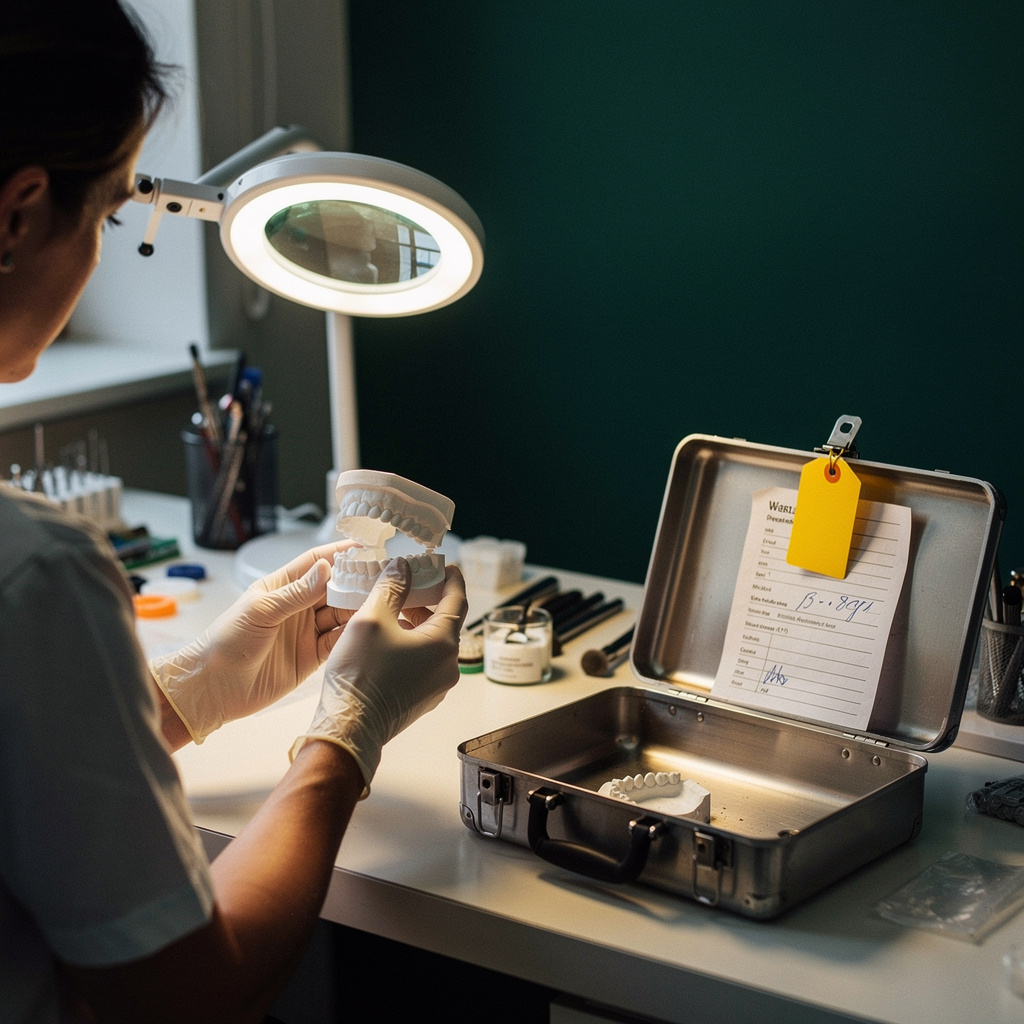
- Missing or incomplete prescription details (shade, material, tooth numbers).
- Margins that cannot be clearly identified on the scan or model.
- Insufficient space for the requested material, as determined by your technician's review. Whether and how to proceed is the clinician's call, so your job is to flag it, not decide.
- Missing opposing arch or bite registration.
- A needed implant component or part that is not on hand.
- Case needs a shade appointment or photo before the esthetic work can proceed.
Then set a rule for how fast you respond. A good standard is contacting the practice within one business day of discovering the problem, stating what is needed, and confirming that the clock resumes when they reply. Make sure the practice can see that a case is on hold and why. A silent pause feels like a missed deadline; a documented one feels like a process.
Set cutoff times and plan for shipping
Two cases that arrive on the same day can have very different outcomes if one arrives at 9 a.m. and the other at 4:45 p.m. Publish a daily intake cutoff. Cases received after it count as the next business day.
On the outbound side:
- Know the real transit time for each carrier and service level to each of your regular practices. Distance matters, and so do pickup times.
- Avoid shipping late in the week unless the practice has confirmed they receive Saturday deliveries or have someone on site to sign.
- Ask each practice for their closed days, such as a Friday off or a half day. Store this on the account so your shipping team does not have to remember it.
- Decide who owns a lost or delayed package. Writing this down once saves a long phone call later.
Write a rush policy with limits
Rush work is where promises most often get broken, because it is usually offered informally. Put structure around it:
- Define what rush means: how many days shorter than standard, for which case types.
- Decide what cannot be rushed, such as cases that need a physical try-in, extended material processing, or components you must order.
- Cap how many rush cases you accept per day so that rush work does not push standard cases past their dates.
- Set a rush fee in a way that is transparent, whether a flat amount or a percentage. The amount is your business decision; the key is that practices see it before they send the case, not on the invoice.
If you cannot meet a rush request, say no clearly and offer the earliest realistic date. A fast no is more useful to a practice than a yes that turns into an apology.
Measure your on-time rate, then adjust the promise
The most common cause of missed dates is promising your best-case speed. Instead, pull a month of cases and compare the date you promised with the date you actually shipped, grouped by case type. Then:
- Calculate what share of each type shipped on or before the promised date.
- For any category where you are regularly late, extend the quoted time rather than pushing the team harder.
- Look at the late cases for patterns: a specific hold reason, a certain day of the week, one stage of production.
- Add a small buffer to categories with unpredictable steps.
A slightly longer promise that you hit nearly every time builds more trust than a shorter one you hit most of the time. Practices schedule patients around your dates, so reliability is worth more to them than the shortest possible number.
Tell practices about delays early
Sometimes a delay is unavoidable: equipment down, a staff shortage, a carrier problem. What matters is when and how you say it. Contact the practice as soon as you know, not on the due date. A short message works:

- What is delayed (patient name or case ID, per your usual identifiers).
- Why, in one plain sentence.
- The new ship and expected delivery dates.
- What, if anything, they need to do, such as rescheduling.
Do not bury the news in an invoice note. Front desk staff reschedule patients all day; giving them a day or two of notice saves them an awkward call with the patient.
A short checklist for this week
- Write your clock-start and clock-stop definitions in two sentences each.
- Decide on business days versus calendar days and publish your holiday closures.
- Build a per-case-type turnaround table, with stages for removable and multi-visit work.
- List your standard hold reasons and set a one-business-day response rule.
- Pick a daily intake cutoff and record each practice's closed days.
- Put limits and a clear fee on rush work.
- Pull last month's promised versus actual dates and adjust quotes to match.
If you list your lab on Dintle, where practices compare labs, see per-case pricing up front, and track orders through delivery, stating your turnaround in the same terms you use internally keeps what practices see consistent with what actually happens at your bench and loading dock.
Clear definitions will not make a slow lab fast, but they will make a good lab look as reliable as it is, and that is usually what keeps a practice sending cases.